Jakarta Globe, November 27, 2013
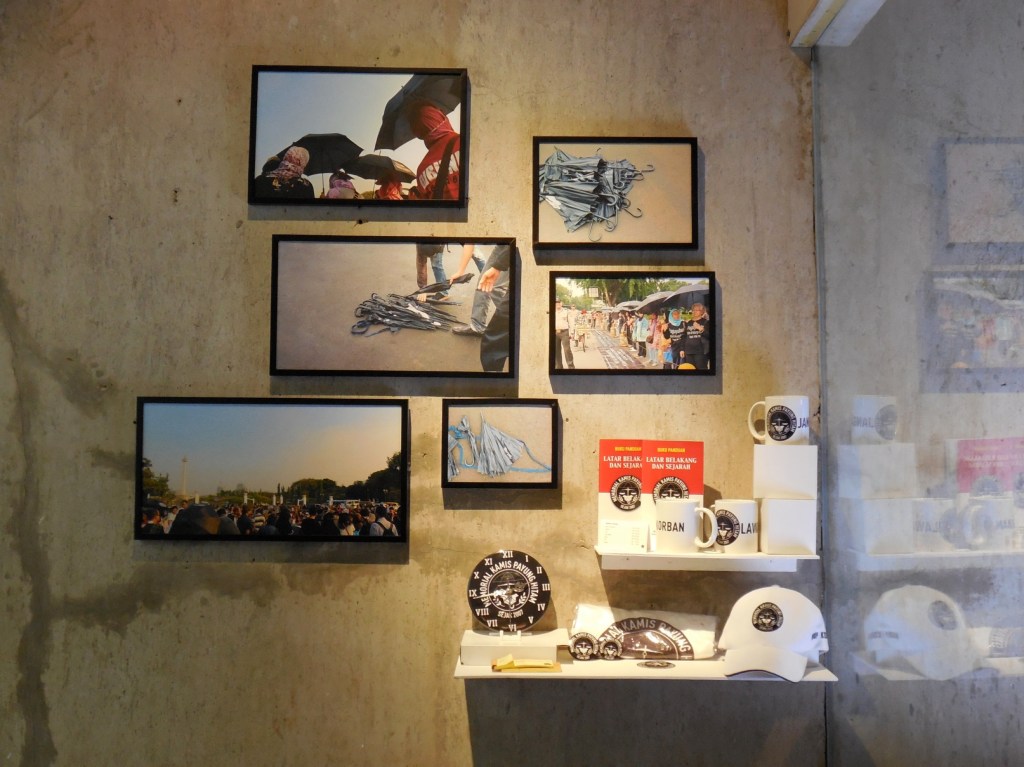
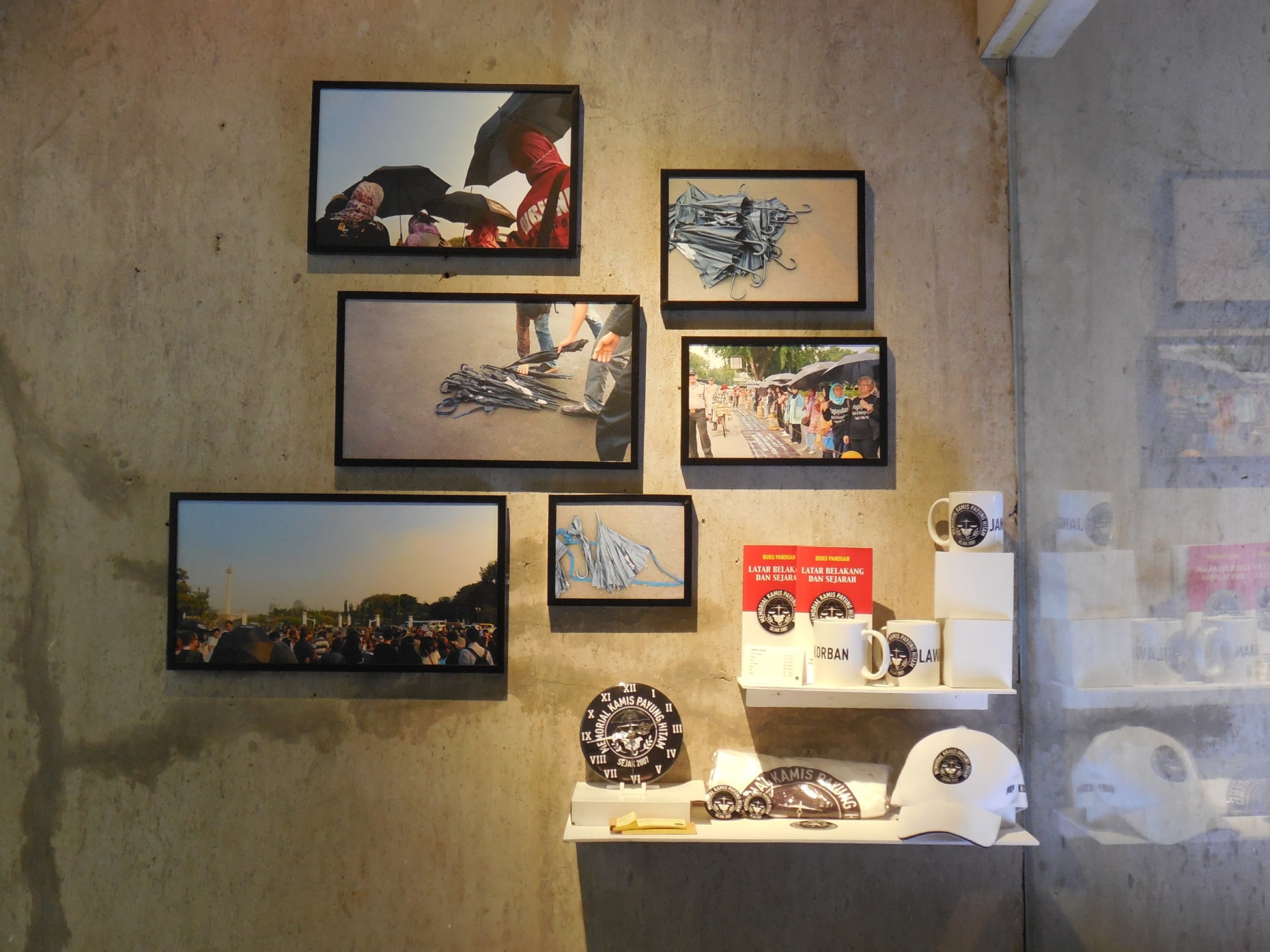
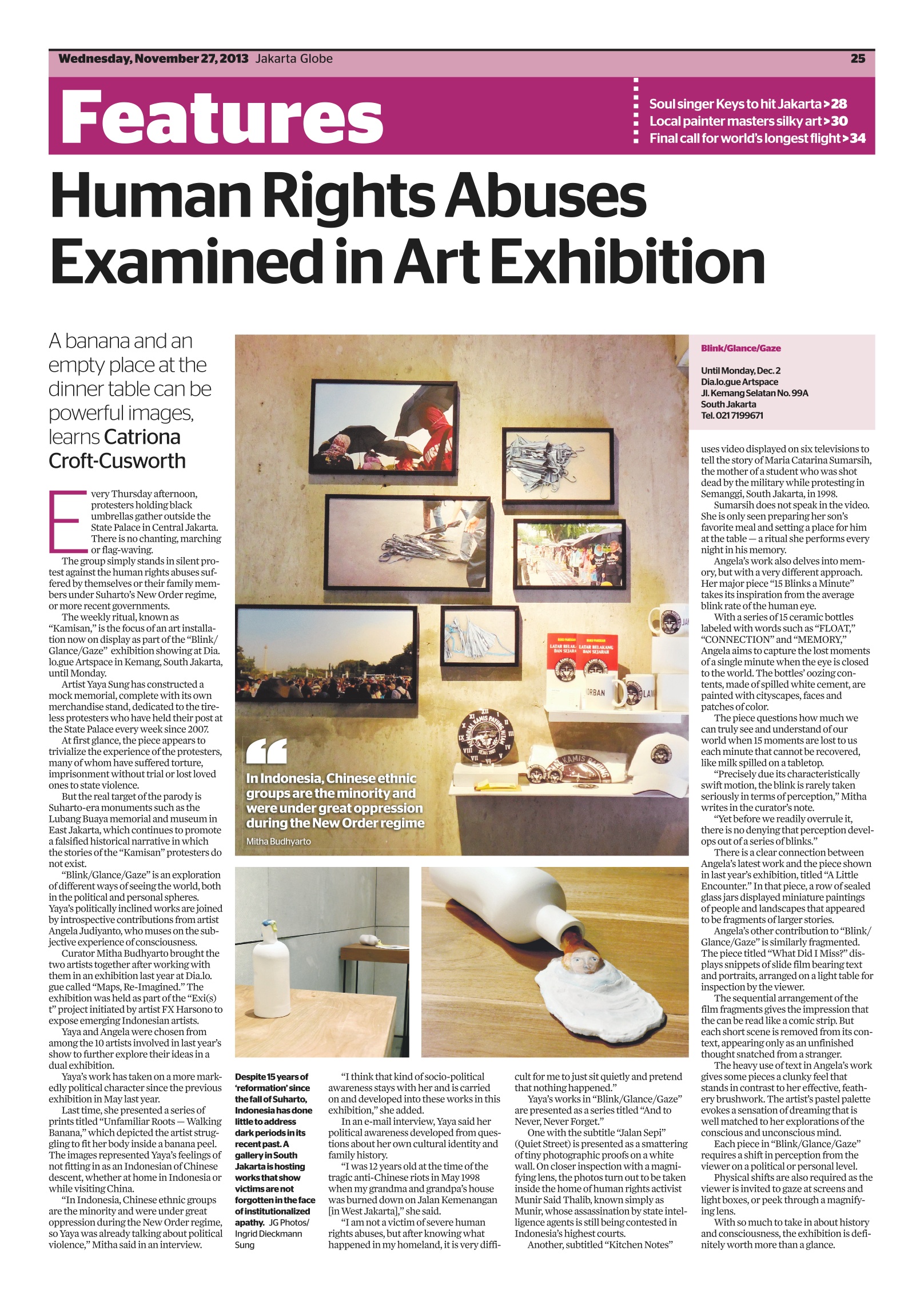
Every Thursday afternoon, protesters holding black umbrellas gather outside the State Palace in Central Jakarta. There is no chanting, marching or flag-waving. The group simply stands in silent protest against the human rights abuses suffered by themselves or their family members under Suharto’s New Order regime.
The weekly ritual known as “kamisan” is the focus of an art installation now on display as part of the “Blink/Glance/Gaze” exhibition showing at Dia.lo.gue Artspace in South Jakarta until Dec. 2.
Artist Yaya Sung has constructed a mock memorial, complete with its own merchandise stand, dedicated to the tireless protesters who have held their post at the State Palace every week since 2007.
At first glance, the piece appears to trivialize the experience of the protesters, many of whom have experienced torture, imprisonment without trial or lost loved ones to state violence.
But the real target of the parody is Suharto-era monuments such as the Lubang Buaya (Crocodile Pit) memorial in East Jakarta, which continue to promote a heavily biased historical narrative in which the stories of the “kamisan” protesters do not exist.
“Blink/Glance/Gaze” is an exploration of different ways of seeing the world, both in the political and personal spheres. Yaya’s politically inclined works are joined by introspective contributions from artist Angela Judiyanto, who muses on the subjective experience of consciousness.
Curator Mitha Budhyarto brought the two artists together after working with them in an exhibition last year at Dia.lo.gue called “Maps, Re-Imagined.” The exhibition was held as part of the “Exi(s)t” project initiated by artist FX Harsono to expose emerging Indonesian artists.
Yaya and Angela were chosen from among the 10 artists involved in last year’s show to further explore their ideas in a dual exhibition.
Yaya’s work has taken on more markedly political character since the previous exhibition in May last year.
Last time she presented a series of prints titled “Unfamiliar Roots – Walking Banana,” which depicted the artist struggling to fit her body inside a banana peel. The images represented Yaya’s feelings of not fitting in as an Indonesian of Chinese descent, whether at home in Indonesia or while visiting China.
“In Indonesia, Chinese ethnic groups are the minority and were under great oppression during the New Order regime, so [Yaya] was already talking about political violence,” Mitha said in an interview.
“I think that kind of socio-political awareness stays with her and is carried on and developed into these works in this exhibition,” she added.
In an email interview, Yaya said her political awareness developed from questions about her own cultural identity and family history.
“I was 12 years old at the time of the tragic anti-Chinese riots in May 1998 when my grandma and grandpa’s house was burned down on Jalan Kemenangan,” she said.
“I am not a victim of severe human rights abuses, but after knowing what happened in my homeland, it is very difficult for me to just sit quietly and pretend that nothing happened.”
Yaya’s works in “Blink/Glance/Gaze” are presented as a series titled “And to Never, Never Forget.”
One with the subtitle “Jalan Sepi” (“Quiet Street”) is presented as a smattering of tiny photographic proofs on a white wall. On closer inspection with a magnifying lens, the photos turn out to be taken inside the home of human rights activist Munir Said Thalib, whose alleged assassination by the state is still being contested in Indonesia’s highest courts.
Another subtitled “Kitchen Notes” uses video displayed on six televisions to tell the story of Maria Catarina Sumarsih, the mother of a student who was shot dead by the military while protesting in Semanggi, South Jakarta, in 1998.
Sumarsih does not speak in the video. She is only seen preparing her son’s favorite meal and setting a place for him at the table – a ritual she performs every night in memory of her son.
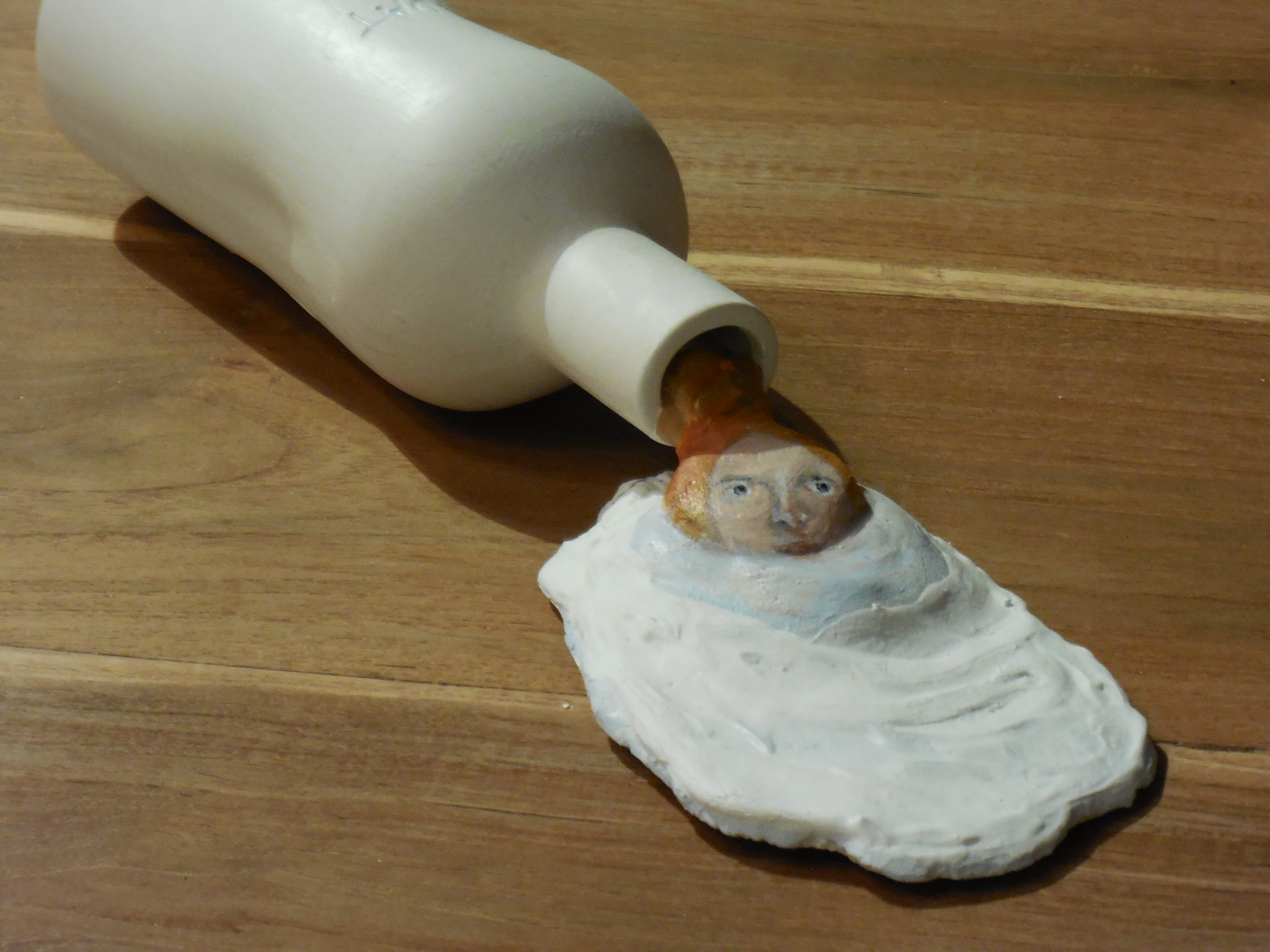
Angela’s work also delves into memory, but with a very different approach. Her major piece “15 Blinks a Minute” takes its inspiration from the average blink rate of the human eye.
With a series of 15 ceramic bottles labeled with words such as “FLOAT,” “CONNECTION” and “MEMORY,” Angela aims to capture the lost moments of a single minute when the eye is closed to the world. The bottles’ oozing contents, made of spilled white cement, are painted with cityscapes, faces and patches of color.
The piece questions how much we can truly see and understand of our world when 15 moments are lost to us each minute that cannot be recovered, like milk spilled on a tabletop.
“Precisely due its characteristically swift motion, the blink is rarely taken seriously in terms of perception,” Mitha writes in the curator’s note.
“Yet before we readily overrule it, there is no denying that perception develops out of a series of blinks.”
There is a clear connection between Angela’s latest work and the piece shown in last year’s exhibition, titled “A Little Encounter.” In that piece, a row of sealed glass jars displayed miniature paintings of people and landscapes that appeared to be fragments of larger stories.
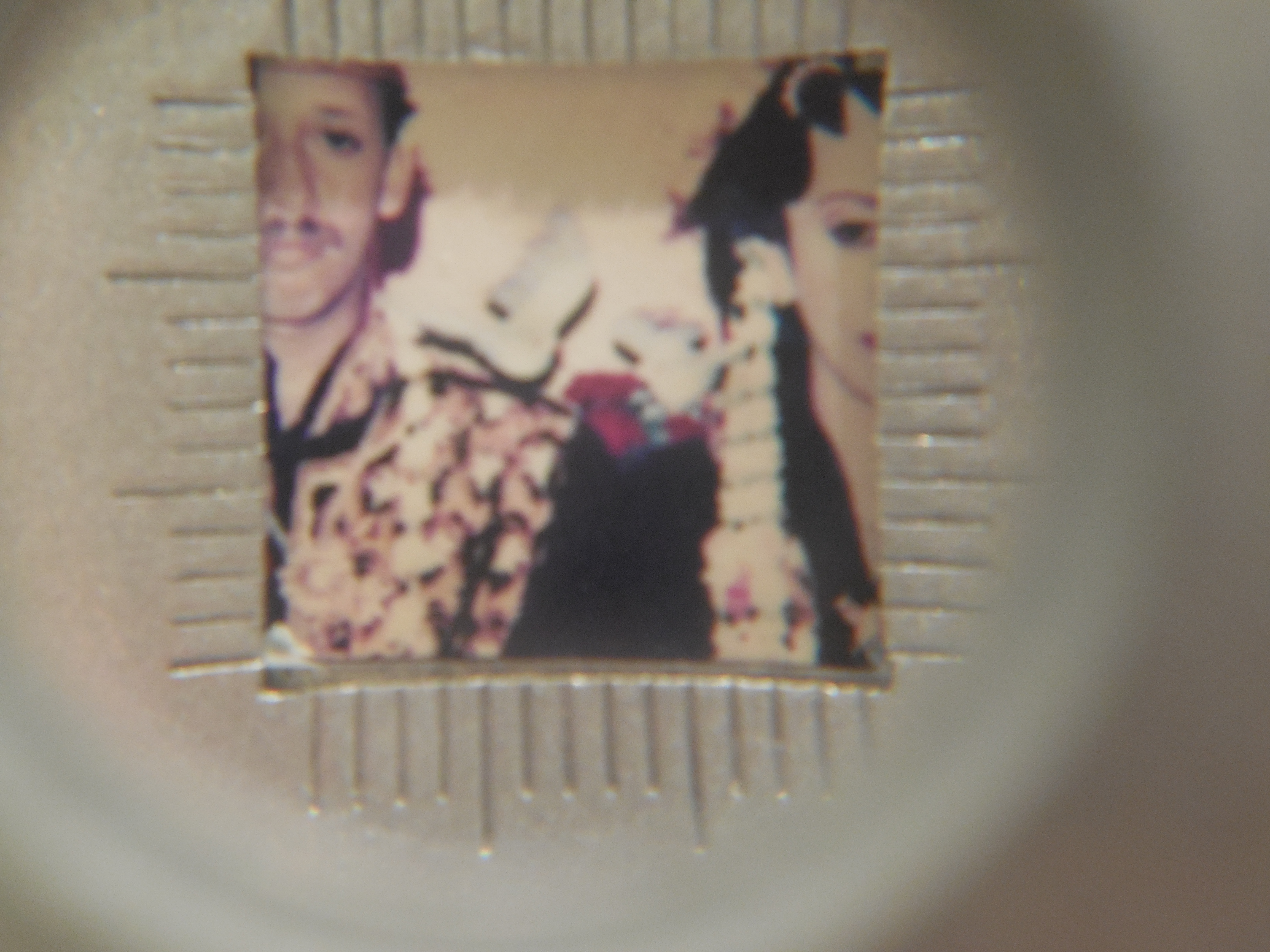
Angela’s other contribution to “Blink/Glance/Gaze” is similarly fragmented. The piece titled “What Did I Miss?” displays snippets of slide film bearing text and portraits, arranged on a light table for inspection by the viewer.
The sequential arrangement of the film fragments gives the impression that the can be read like a comic strip. But each short scene is removed from its context, appearing only as an unfinished thought snatched from a stranger.
The heavy use of text in Angela’s work gives some pieces a clunky feel that stands in contrast to her effective, feathery brushwork. The artist’s pastel palette evokes a sensation of dreaming that is well matched to her explorations of the conscious and unconscious mind.
Each piece in “Blink/Glance/Gaze” requires a shift in perception from the viewer on a political or personal level. Physical shifts are also required as the viewer is invited to gaze at screens and light boxes, or peek through a magnifying lens.
With so much to take in about history, memory and the nature of consciousness, the exhibition is definitely worth more than a surface glance.

 Catriona Richards
Leave a comment