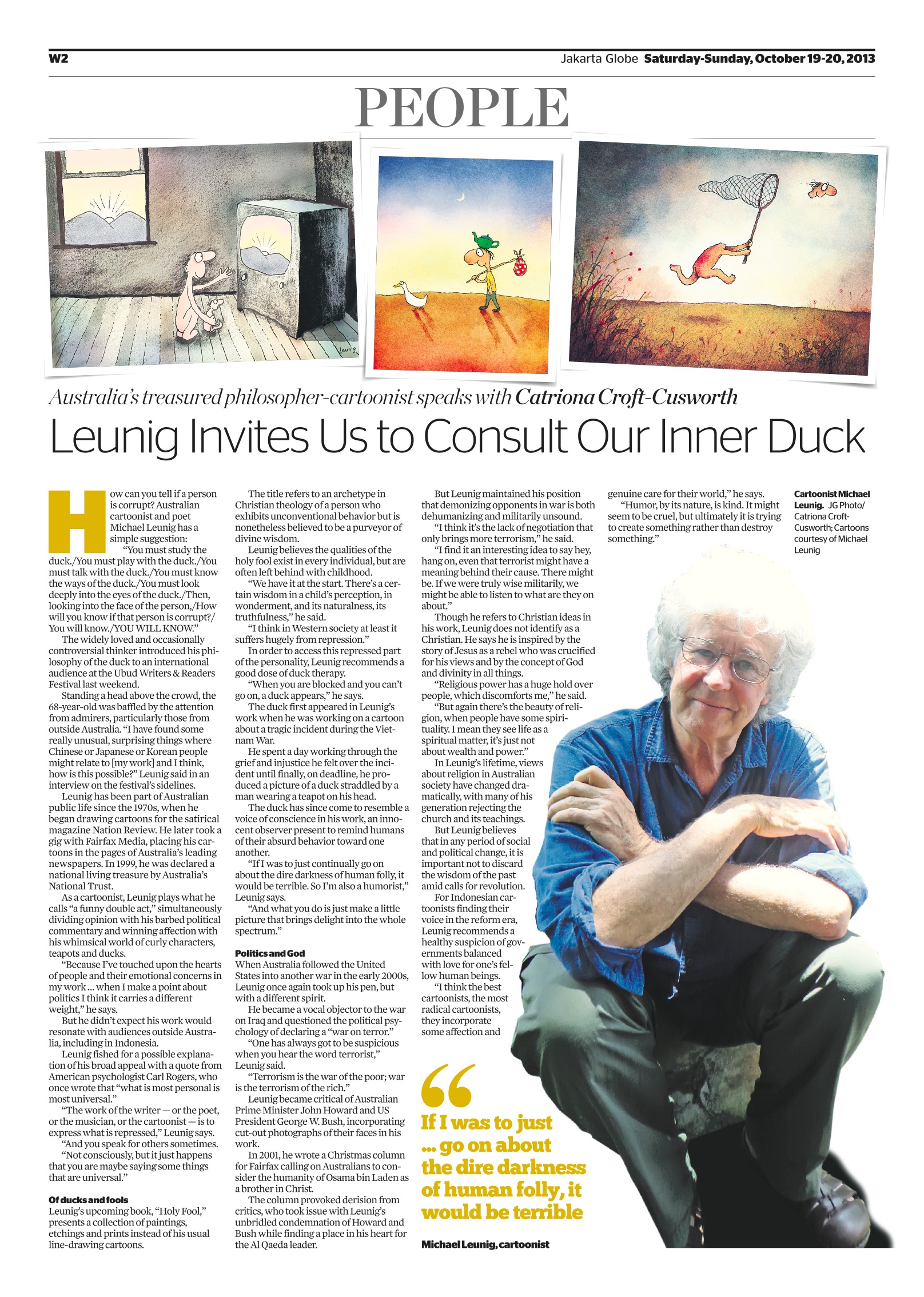
Jakarta Globe, October 20, 2013
How can you tell if a person is corrupt? Australian cartoonist and poet Michael Leunig has a simple suggestion:
“You must study the duck./You must play with the duck./You must talk with the duck./You must know the ways of the duck./You must look deeply into the eyes of the duck./Then, looking into the face of the person,/How will you know if that person is corrupt?/You will know./YOU WILL KNOW.”
The widely loved and occasionally controversial thinker introduced his philosophy of the duck to an international audience at the Ubud Writers & Readers Festival last weekend.
Standing a head above the crowd, the 68-year-old was baffled by the attention from admirers, particularly those from outside Australia. “I have found some really unusual, surprising things where Chinese or Japanese or Korean people might relate to [my work] and I think, how is this possible?” Leunig said in an interview on the festival’s sidelines.
Leunig has been part of Australian public life since the 1970s, when he began drawing cartoons for the satirical magazine Nation Review. He later took a gig with Fairfax Media, placing his cartoons in the pages of Australia’s leading newspapers. In 1999, he was declared a national living treasure by Australia’s National Trust.
As a cartoonist, Leunig plays what he calls “a funny double act,” simultaneously dividing opinion with his barbed political commentary and winning affection with his whimsical world of curly characters, teapots and ducks.
“Because I’ve touched upon the hearts of people and their emotional concerns in my work … when I make a point about politics I think it carries a different weight,” he says.
But he didn’t expect his work would resonate with audiences outside Australia, including in Indonesia.
Leunig fished for a possible explanation of his broad appeal with a quote from American psychologist Carl Rogers, who once wrote that “what is most personal is most universal.”
“The work of the writer — or the poet, or the musician, or the cartoonist — is to express what is repressed,” Leunig says.
“And you speak for others sometimes.
“Not consciously, but it just happens that you are maybe saying some things that are universal.”
Of ducks and fools
Leunig’s upcoming book, “Holy Fool,” presents a collection of paintings, etchings and prints instead of his usual line-drawing cartoons.
The title refers to an archetype in Christian theology of a person who exhibits unconventional behavior but is nonetheless believed to be a purveyor of divine wisdom.
Leunig believes the qualities of the holy fool exist in every individual, but are often left behind with childhood.
“We have it at the start. There’s a certain wisdom in a child’s perception, in wonderment, and its naturalness, its truthfulness,” he said.
“I think in Western society at least it suffers hugely from repression.”
In order to access this repressed part of the personality, Leunig recommends a good dose of duck therapy.
“When you are blocked and you can’t go on, a duck appears,” he says.
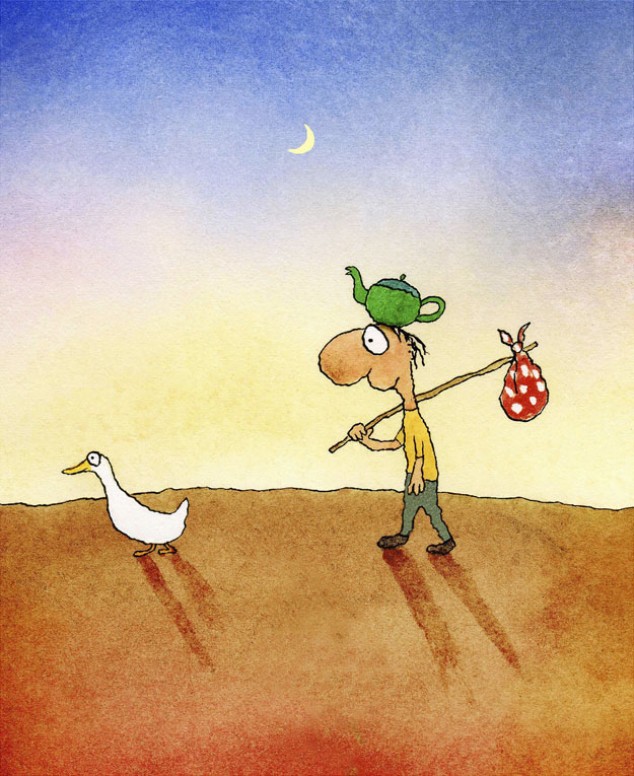
The duck first appeared in Leunig’s work when he was working on a cartoon about a tragic incident during the Vietnam War.
He spent a day working through the grief and injustice he felt over the incident until finally, on deadline, he produced a picture of a duck straddled by a man wearing a teapot on his head.
The duck has since come to resemble a voice of conscience in his work, an innocent observer present to remind humans of their absurd behavior toward one another.
“If I was to just continually go on about the dire darkness of human folly, it would be terrible. So I’m also a humorist,” Leunig says.
“And what you do is just make a little picture that brings delight into the whole spectrum.”
Politics and God
When Australia followed the United States into another war in the early 2000s, Leunig once again took up his pen, but with a different spirit.
He became a vocal objector to the war on Iraq and questioned the political psychology of declaring a “war on terror.”
“One has always got to be suspicious when you hear the word terrorist,” Leunig said.
“Terrorism is the war of the poor; war is the terrorism of the rich.”
Leunig became critical of Australian Prime Minister John Howard and US President George W. Bush, incorporating cut-out photographs of their faces in his work.
In 2001, he wrote a Christmas column for Fairfax calling on Australians to consider the humanity of Osama bin Laden as a brother in Christ.
The column provoked derision from critics, who took issue with Leunig’s unbridled condemnation of Howard and Bush while finding a place in his heart for the Al Qaeda leader.
But Leunig maintained his position that demonizing opponents in war is both dehumanizing and militarily unsound.
“I think it’s the lack of negotiation that only brings more terrorism,” he said.
“I find it an interesting idea to say hey, hang on, even that terrorist might have a meaning behind their cause. There might be. If we were truly wise militarily, we might be able to listen to what are they on about.”
Though he refers to Christian ideas in his work, Leunig does not identify as a Christian. He says he is inspired by the story of Jesus as a rebel who was crucified for his views and by the concept of God and divinity in all things.
“Religious power has a huge hold over people, which discomforts me,” he said.
“But again there’s the beauty of religion, when people have some spirituality. I mean they see life as a spiritual matter, it’s just not about wealth and power.”
In Leunig’s lifetime, views about religion in Australian society have changed dramatically, with many of his generation rejecting the church and its teachings.
But Leunig believes that in any period of social and political change, it is important not to discard the wisdom of the past amid calls for revolution.
For Indonesian cartoonists finding their voice in the reform era, Leunig recommends a healthy suspicion of governments balanced with love for one’s fellow human beings.
“I think the best cartoonists, the most radical cartoonists, they incorporate some affection and genuine care for their world,” he says.
“Humor, by its nature, is kind. It might seem to be cruel, but ultimately it is trying to create something rather than destroy something.”

 Catriona Richards
Leave a comment