

Jakarta Globe, June 4, 2012
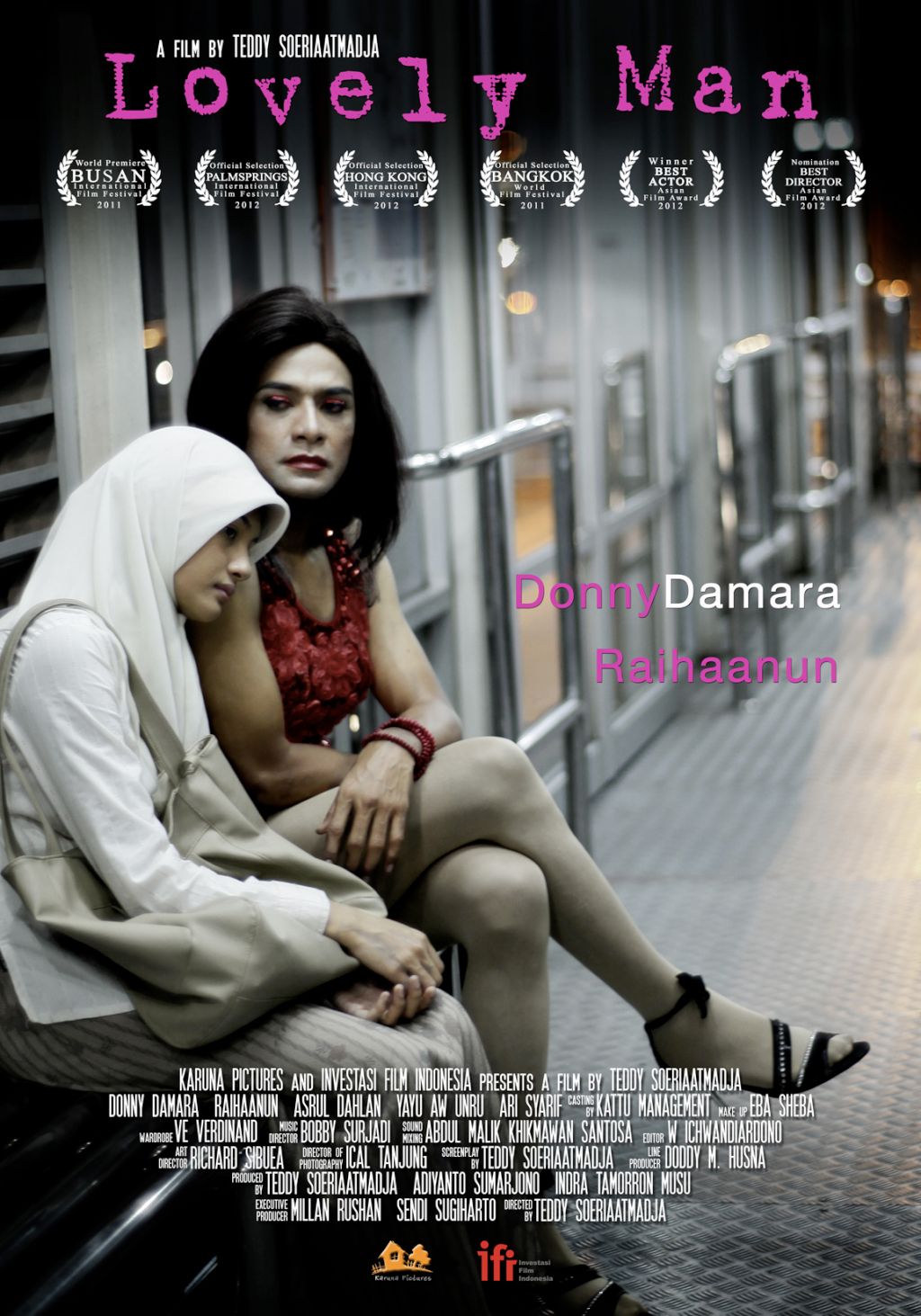
One night almost 10 years ago, filmmaker Teddy Soeriaatmadja witnessed an unusual sight. Passing through the dimly lit backstreets of Central Jakarta, he saw a girl wearing a headscarf, deep in conversation with a transgender prostitute.
That night, Teddy continued on his way to film a TV commercial in the area, a popular spot for advertisers due to its picturesque buildings and tree-lined avenues. But the memory of that image stuck with him.
Fast forward nine years, and Teddy’s film “Lovely Man” was winning praise at film festivals around the world, including an Asian Film Award for Best Actor for its lead Donny Damara.
“Lovely Man” tells the story of a devout Muslim girl (Raihaanun) who comes to the city to reunite with her estranged father, played by Donny. She finds him dressed as a woman and selling himself in the notorious red-light district near Taman Lawang in Central Jakarta.
Last weekend, the film ended a brief run in cinemas here, drawing a small but appreciative audience, though like most local films, it was ultimately overshadowed by the latest Hollywood blockbusters.
The subject matter is a sensitive one for Indonesian audiences, used to seeing transgenders as little more than figures of comic relief in slapstick comedies. But it was a story Teddy wanted to tell.
“Honestly, when I made this film, I didn’t want to release it in Indonesia because I thought the content was a bit too extreme,” Teddy said.
The film made its local premiere at the queer Q! Film Festival last year, an event that in previous years has been stormed by machete-wielding hard-liners from the Islamic Defenders Front (FPI).
Despite the risks, Teddy was confident that the story in his film was a universal one, about family.
“When you actually see the film you have to sort of erase the whole transgender and the headscarf thing,” he said. “It’s just a film about a father and a daughter. I don’t think it should be offensive.”
But Teddy knew it was going to be a hard sell. “No one would want to fund a film about a transgender and a Muslim girl,” he said.
Determined to take the story to the screen, Teddy funded the film himself, as well as writing the script and directing it.
The funds came from Teddy’s day job, shooting two to three commercials a month. He makes commercials for a living so that his own films are not commercialized.
“I really like doing films but I try not to do films for other people right now,” he said. “I’ve done it before and I’ve never been quite happy with it.”
A graduate in human behavior studies at Newport University in London, Teddy’s main interest lies in human beings and how they interact.
His studies led him to take a position in human resources working for the Coca-Cola Company. But after a year, he knew that the “nine-to-five” life wasn’t for him. After that, he spent some time making music videos for friends before finally putting together his first feature film.
Teddy can’t explain why he first felt the urge to pick up a video camera: “I just had to,” he said.
Freed from the constraints of pleasing producers, Teddy has mainly been able to make films the way he wants to.
His first film, “Banyu Biru” (“Waking Banyu”), released in 2005, won him Best Director at the Bali International Film Festival.
His next film, the 2006 production “Ruang” (“The Letter”) was another small-scale film, telling the story of a forbidden love.
But not all of Teddy’s films have been independent ventures. In 2007, he was involved in a big-budget remake of the classic Indonesian film “Badai Pasti Berlalu” (“This Storm Shall Pass”), produced by Astral Pictures.
He also made a teen comedy in 2008 with soap opera producer Manoj Punjabi, called “Namaku Dick” (“My Name is Dick”).
But after these forays into the commercial realm, Teddy decided that his biggest loyalty was to himself, and making the kinds of films that were true to his values.
He returned to independent filmmaking in 2009 with “Ruma Maida” (“Maida’s House”), which received 13 nominations in the Indonesian Film Festival (FFI), bagging one for Best Sound Design.
Like his idol Woody Allen, Teddy now aims to make one film a year, always putting the story first.
“Woody Allen is a fantastic storyteller,” Teddy said. “Not to compare myself to him, but that’s what I want to do,” he added.
“Lovely Man” sees Teddy once again taking the storyteller’s chair, as viewers are guided through the overcrowded neighborhoods of Central Jakarta.
Like those fearless figures he saw on the street almost 10 years ago, Teddy shows with this film he has the courage to stand out in a crowd.

 Catriona Richards
Leave a comment