Jakarta Globe, February 17, 2012
Printmakers have always been the rebels of the art world. Their craft requires a mix of brute strength and careful precision, free expression and attention to detail, as it walks the fine line between what is mass-produced and what is art.
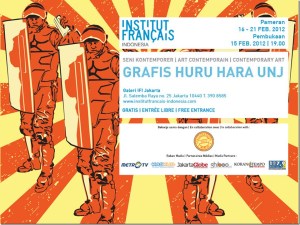
This weekend, 18 printmakers from Jakarta State University (UNJ) are exhibiting their best works at the Institut Francais in Central Jakarta, in a show titled “Grafis Huru Hara,” or “Riot Graphics.”
Their works do not all center on themes of political dissent, though anarchist punks and riot police armed with spray cans do feature among the collection. Instead, the pieces on display express the personal hopes, fears and imagination of the students who created them.
Curator M. Sigit Budi explained that the “riot” in the exhibition’s title is more of a creative label, rather than a political one.
“Whenever UNJ students get together, it is always a pretty rambunctious gathering,” he said at the opening on Wednesday, as students laughed and yelled in the echoing exhibition space. “So the ‘riot’ comes from their spirit to express and create.”
The exhibition itself is certainly a riot of color — brightly painted masks and woodblock prints adorn the walls, stenciled chopping boards hang from the ceiling and army tanks plastered with cartoon characters clutter the floor.
Guiding viewers through the exhibit is a trail of monkey paw prints, stamped along the floor, up the walls and finally leading to the cheeky primate itself, hanging upside down from the air-conditioning unit on the back wall.
Standing nearby with a similar grin on Wednesday was the artist responsible for the piece, 22-year-old Amy Zaharawan.
Amy said the woodblock print on foam rubber, titled “Terbalik” (“Upside Down”), was an expression of his own character.
“It’s a lot like me, because it’s wild, not because it’s a monkey!” he said with a laugh. “I have a wild spirit to go where I want and do what I want.”
While studying design at UNJ, Amy has already started developing a name for himself off campus, holding exhibitions in Jakarta and Bandung and contributing designs for T-shirt companies.
Being wild, he said, doesn’t necessarily mean being bad: “It’s about freedom.”
The idea of freedom also featured in a work titled “Stuck in the Box,” by 23-year-old Panji Purnama Putra, known as Jin.
Made of two wooden boxes stenciled with red diamonds, Jin’s piece resembled something of a circus attraction, with a peephole cut in the front that viewers could not resist peeking into.
Inside, an arrangement of mirrors revealed a black-and-white woodblock print of a creature in a tortured mess of fur and eyes. For Jin, the piece represents the difficulty of thinking “outside the box.”
“It’s hard to change the way we think sometimes,” he said. “But it’s important to be open to new ideas and think outside of what we already know.”
The young artist has exhibited works in Jakarta and Yogyakarta, and enjoys experimenting with different media to keep the ideas flowing. He also designed the striking blue stenciled wallpaper that welcomes visitors to the exhibition.
One of the youngest artists in the exhibition, and one of only two female artists there, was 19-year-old Retno Tiawan, better known as Eno. She said few women were interested in studying printmaking because of the manual labor associated with it.
“It’s messy, and for some types of printing, like woodblock, you have to be quite strong to carve the image,” she said.
But mess and the prospect of putting in some elbow grease have not deterred Eno, who has been studying printmaking and design at UNJ for three years.
Instead of the knuckle-breaking work of woodcarving, Eno has taken up drypoint as her printing technique of choice. The technique involves etching a fine image into a plate of copper or zinc, or in Eno’s case, acrylic plastic.
Unlike woodblock or linocut prints, drypoint prints show the printed image in positive form instead of negative form, as the ink is collected in the etched lines and printed onto the paper.
Eno transferred her love of drawing into the production of drypoint prints that feature her performing everyday activities, such as riding her scooter or hanging out with her boyfriend, but with an imaginative touch; many of her prints include kooky, alien-esque creatures, and it is these figures that make her work distinctive.
For the exhibition, she presented a selection of prints framed in the shape of a house, titled “Mine.”
“It’s just about me and my life, and the things I imagine,” she said.
Each artist in “Grafis Huru Hara” also made a print on A4 paper to display in the art space’s entrance hall, and copies of these from the original print runs are included in the exhibition catalogue. The handmade volume is a bargain at Rp 100,000 — it’s not often that you can take home the art from an exhibition for only $11.
And therein lies the beauty of printmaking: Every original is a copy, and every copy is unique. In the world of art, preoccupied with originality and authenticity, it’s no wonder why printmakers cause something of a riot.
Grafis Huru Hara
Until Tuesday, Feb. 21
Institut Francais Indonesia
Jl. Salemba Raya No. 25
Central Jakarta
Tel. 021 3908585

 Catriona Richards
Leave a comment