Jakarta Globe, January 20, 2012
Despite its villainous reputation among the guardians of intellectual property rights, the copy-and-paste function on computers is infinitely useful for quickly obtaining, sharing and organizing information. The people at the Indonesian Visual Art Archive are making good use of the function by compiling a series of four data catalogs in the form of scrapbooks, the final volume of which was launched at the ruangrupa art space last Friday.
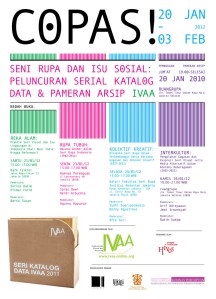
To celebrate the launch, ruangrupa is also hosting an exhibition of archival goodies until Feb. 3 titled “COPAS!” — a contraction of “copy-and-paste.”
Discussions on each of the catalog topics — ranging from gender and environmental issues to creative collaboration and alternative media — will be held at cultural venues across the capital this week.
“There’s a hint of irony in the title [‘COPAS!’], because in this era, it’s all about copy-paste,” said Farah Wardani, executive director of IVAA. “This is a copy-and-paste approach to history, but for a good cause!”
In a country where written information on artists and their work can be hard to find, IVAA has been cataloging data on the art world since 1995, when it was formed as part of the Cemeti Art Foundation (now Cemeti Art House) in Yogyakarta.
The archives now contain thousands of records ranging from photographs to video footage, reference texts, exhibition catalogs, art reviews and original works from Indonesia’s best-known artists.
With the four-volume catalog and public exhibition, IVAA aims to open the vault to the public, allowing students, researchers and art enthusiasts to look back at the development of the country’s canon of modern art.
The catalogs are presented in a matching set and packed full of interesting tidbits relating to each theme. The accompanying text connects the archival outtakes, stringing together a narrative on the development of modern art in Indonesia.
“We’ve made something like a mixed tape,” Farah said. “It’s not a big history book — more like a compilation, actually.
Each volume aims to provide an account of the development of certain themes in Indonesia’s art history.
For example, the first volume, titled “Rupa Tubuh” (“Body Visuals”), traces the development of ideas about gender in Indonesian art from the work of female painter Emiria Soenassa in the 1940s to Affandi’s sketches of female nudes in the 1970s. The volume culminates with photographs of installations and performance art in the early 2000s.
Volumes two and three take a similar approach to the themes “Reka Alam” (“Imagining Nature”) and “Kolektif Kreatif” (“Creative Collectives”), tracing arts movements back to the romantic Mooi Indie paintings of the 19th century through newspaper comic strips, avant-garde sculpture and the prolific arts collectives active in the scene today.
The fourth volume, “Interkultur” (“Interculture”), released at the exhibition opening, takes a look at Indonesia’s visual arts and alternative media in the context of the nation’s diversity. It is a volume well-suited to Jakarta, where diverse groups negotiate a peaceful coexistence on a day-to-day basis. The theme of diversity is discussed in the context of nation-building and politics.
“Historically, visual art in Indonesia has always had a connection to culture and politics,” Farah said. “That’s why we want to see what issues are relevant today and how visual arts relate or engage with those.”
All images are presented in black and white, but a CD containing a PDF version of the book in color is provided with each volume, making the information easy to share with others online — something IVAA has no qualms about.
“A lot of people don’t know what we do at IVAA, or what’s in our collection,” Farah said. “So the idea of the catalog is to make it more accessible.”
The catalogs will be distributed free to schools, libraries and nongovernmental organizations working in the arts. Hard copies will be made available to the public for around Rp 120,000 ($13) each, with a discounted price yet to be announced for sale at the exhibition.
The “COPAS!” exhibition itself is presented in the style of an abandoned office, with archival material projected and mounted on the walls. The pieces on display are all copies from the archives, turning the files themselves into artifacts of Indonesian art history.
Farah also hopes that a look back to the past will help artists today find inspiration for the future. “These days there is a tendency for artists to be more market-driven, without making a statement about anything,” she said. “So the exhibition is also a kind of reminder that we want artists to always speak, to provoke and to engage with society.”
COPAS!
Until Friday, Feb. 3
ruangrupa
Jl. Tebet Timur Dalam Raya No. 6
South Jakarta
Tel. 021 8304220
Reka Alam
A discussion with Enrico Halim and Hilmar Farid about art and the environment
Saturday, Jan. 21, from 3 p.m. to 5 p.m.
Kafe Tjikini
Jl. Cikini Raya No. 17
Central Jakarta
Rupa Tubuh
A discussion with Saras Dewi and Heidi Arbuckle on art and gender
Monday, Jan. 23, from 3 p.m. to 5 p.m.
Komnas Perempuan
Jl. Latuharhary No. 4B
South Jakarta
Kolektif Kreatif
A discussion with Yudhi Soerjoatmodjo and Ronny Agustinus on art collectives
Tuesday, Jan. 24, from 3 p.m. to 5 p.m.
Galeri Fakultas Seni Rupa, Institut Kesenian Jakarta
Jl. Cikini Raya No. 73Taman Ismail Marzuki
Central Jakarta
Interkultur
A discussion with Arif Adityawan and Jemi Irwansyah on alternative media, diversity and art
Thursday, Jan. 26, from 7 p.m. to 9 p.m.
ruangrupa
Jl. Tebet Timur Dalam Raya No. 6
South Jakarta
Tel. 021 8304220
For more information, visit http://www.ivaa-online.org

 Catriona Richards
Leave a comment