Jakarta Globe, December 11, 2011
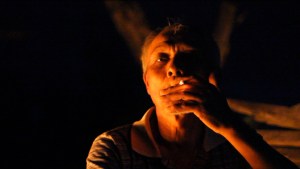
Sitting by the remains of his former house, Cangkringan resident Purdiwiyono squints into the campfire and inhales deeply on a kretek cigarette. “I saw black and red everywhere,” he recounts. “I thought the eruption would destroy everything. I was right.”
Like many residents of the villages clinging to Mount Merapi’s slopes in Central Java, Purdiwiyono lost everything he owned in the 2010 eruption that killed more than 300 people and left tens of thousands homeless. He now lives in a shelter, but often returns to the site of his former home to reflect on his past. His story is one of dozens collected by Australian student Josephine Lie in an interactive documentary titled “Merapi: Stories from the Volcano.”
The online documentary is divided into personal stories from people who were impacted in varying degrees by the volcano’s eruption. Viewers can choose which stories they want to watch and in what order by selecting different points on a virtual map laid out in the shape of the volcano. The stories are linked on a side panel under themes such as “Evacuation,” “Shelters,” “Assistance” and “Communication.”
Lie was inspired to make the documentary after hearing stories about the eruption from friends in Yogyakarta, where she spent a year on a student exchange in 2009.
“My friends kept telling me stories about where they were and what they were doing during the eruption,” she says. “They just filtered these anecdotes into everyday conversation, but to me it was remarkable. I thought if other people heard these stories they could really get a feeling of what it’s like to live near a volcano.”
Lie made a second trip back to Yogyakarta six months later to gather the stories on film. In 15 days she conducted 25 interviews with people still living in shelters, those who had helped as volunteers, business owners and others affected. Despite the short time frame for her project, Lie found that people were willing to help at short notice, and eager to tell their stories.
“From a researcher’s point of view, what Indonesia lacks in structure and punctuality, it makes up for in enthusiasm and generosity,” she says. “There’s no way people would give you the time of day back in Sydney to do that many interviews in that short amount of time.” For Lie, the project was also a way to bridge the gap in understanding between Indonesian and Australian culture, something close to her own identity.
Born in Australia to Indonesian parents, Lie felt disconnected from her family’s cultural roots until she went to study in Yogyakarta two years ago. Upon return to Australia, she felt disconnected once again, but this time from Australian culture.
“A lot of my friends don’t have a huge understanding of the Indonesian people or the culture and how diverse it can be,” she says. “People have been surprised, especially by some of the less conservative interviewees in the documentary, that they could exist in a context like Indonesia.”
One of the more surprising stories comes from Uki Darban, a member of Yogyakarta’s lesbian, gay, bisexual and transgender community, who offered assistance after the eruption by providing free haircuts and salon treatments to survivors living in camps and shelters.
“In the shelters, there’s not much time to cut or wash your hair. So we decided to do this for them,” Uki explains. “People were very enthusiastic — there were long lines. We would finish with one shelter and then a different shelter would want haircuts too.”
Another astonishing story comes from Inna Hudaya, a member of an aid organization that coordinated village evacuations at the time of the eruption. Inna describes the harrowing task of driving through ash-clogged areas with minimal visibility, and inadequate equipment. Stepping out of the car to find people to evacuate, Inna and other volunteers had only helmets and swimming goggles to protect them from the falling ash and gravel. But as she recounts her story, Inna bursts into laughter.
“I should be the star for advertising Speedo [swimming goggles],” she jokes suddenly in English, posing like a billboard model. “Speedo: Saving Lives!”
Each of the stories in the documentary is interspersed with shots of landscapes, homes, food and people performing everyday tasks to create a more complete portrait of each person and his or her way of life. The result is a textured portrayal of Yogyakarta itself, from the sounds of traffic and the buzz of insects in the paddy fields to kettles boiling, music playing and friends chatting.
One year after the eruption, many people are still living in shelters and trying to rebuild their lives and livelihoods. But in other ways, the documentary shows that Yogyakarta is the same as it has always been.
Despite the tragedy, many appear willing to accept that Merapi is a constant threat, but one that people in Central Java have learned to live with for centuries.
For Purdiwiyono, losing his home and some of his neighbors is still not enough to drive him away from the land he considers home. “I preferred to come back here,” he said, watching scraps of wood from his former home burn in the campfire. “Relocating is not for me.”
‘Merapi: Stories from the Volcano’
By Josephine Lie
merapistories.com

 Catriona Richards
Leave a comment