Jakarta Globe, December 2, 2011
As the popular saying goes, “If you can’t stand the heat, get out of the kitchen.” The sentiment has been embraced by the curators of this year’s Jakarta Biennale, the capital’s biggest art show, which has adopted the title “Maximum City: Survive or Escape?” In this case, the kitchen is Jakarta, or any of the world’s mega-cities overflowing with people and problems. And the question posed to the world’s artists is: Can you stand the heat?
Curated by arts writer Bambang Asrini Widjanarko, Kompas journalist Ilham Khoiri, Tempo writer Seno Joko Suyono and Manila-based writer and editor Eileen Legaspi-Ramirez, this year’s Biennale brings together artists from throughout the region and further afield to give their take on the paradoxes of urban life.
In Jakarta, the paradoxes are clear: Rich coexisting with poor, modernity with tradition, tolerance with bigotry.
In the words of the event’s curators, the question for Jakarta becomes: “Will we simply carry on while looking for solutions, engrossed in our own journeys, or will we eventually flee from the overcrowded city and all its problems?”
Despite conflicting ideologies, poor infrastructure, grid-locked streets and overcrowded housing, more people arrive in the capital each year, and those already here seem reluctant to leave. The city proves that opposites not only attract, but can help each other to develop, for better or worse.
The main event for the Biennale kicks off on Dec. 15 at the National Gallery, where a monthlong exhibition of contemporary works will be presented. Ancillary events have been held since the middle of the year.
Wednesday marked the opening of a lithography exhibition titled “The Birth of Maximum City,” showing prints of Dutch-era Jakarta, known then as Batavia.
“The origins of Jakarta’s opposing extremes can be seen in the city plans for old Batavia, where rich, cosmopolitan inhabitants were segregated from other migrants who were brought in as slaves,” said Dimas Fuady, media relations coordinator of the Jakarta Biennale.
As for the origins of the Jakarta Biennale itself, the event was first held back in 1968, under the name “The Grand Painting Exhibition” ( Pameran Besar Seni Lukis), and this year marks its 14th ed ition.
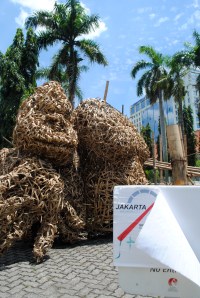
But if this is the first you’ve heard of the Biennale, you are not alone. Outside of art circles, the event has received little public attention, with only Rp 3 billion ($330,000) made available this year by the Jakarta Arts Council (DKJ) for more than six months’ worth of events covering everything from music and theater to visual arts. The Biennale hopes to raise awareness this year by erecting art installations at public sites like malls, train stations and city parks.
The overarching theme, “Maximum City,” is broken down into five sub-themes: “Violence and Resistance”; “Narcissism, Voyeurism and the Body”; “Game, Leisure and Gadget Victim”; “Metro-Text Seductions”; and “Homo Ludens,” or “Playing Man.” The wide scope has elicited a variety of responses, not just from painters and sculptors but also street artists, fashion designers, toy makers and animators.
Two Indonesian artists, Heri Dono from Yogyakarta and Tisna Sanjaya from Bandung, will work with communities to create outdoor installations under the “Homo Ludens” sub-theme.
Curator Bambang said that working in the public sphere had become a necessary step for many contemporary artists. “Art is becoming ever closer to everyday life, and the public sphere is the ideal place for art to interact with a wider audience,” he said.
Bambang said that Heri planned to collaborate with arts community the Wedha Portrait Art Project to create an installation in South Jakarta’s Taman Ayodya. Portraits of everyday visitors to the park, from scavengers to criminals, writers, artists and public officials, will be presented inside a gazebo and on raised boxes in the middle of the park’s small lake.
Meanwhile, Tisna plans to create a temporary doll museum near the train station in Kampung Rambutan, in East Jakarta, in collaboration with arts collective Komunitas Atap Alis. Tisna plans to recruit schoolchildren, as well as kids who had to quit school due to financial circumstances, to help create the dolls for the museum out of recycled materials and rubbish.
No venture into the public realm in Jakarta would be complete without stepping into the city’s malls, where a large slice of the population spends much of their free time shopping, eating and socializing. From Dec. 9 to 10, a selection of works from the “Mata Perempuan” (“Women’s Eyes”) amateur photography competition, which closed on Wednesday, will be presented at fX Lifestyle X’nter in South Jakarta.
Women of all ages were invited to submit cellphone images via social media that express how they view their own lives (or the lives of people around them) as citizens of Jakarta. The 30 best images will be selected by Biennale representatives for the upcoming exhibition at fX.
Central Park Mall in East Jakarta will be a venue under the sub-theme “Game, Leisure and Gadget Victim.” Artists have been invited to respond to the lifestyles and fetishes spawned by the dominance of consumerism in the city’s urban culture.
Suggesting alternative forms of entertainment for city dwellers, events under the “Metro-Text Seductions” sub-theme will highlight Indonesia’s literary arts. On Friday, representatives from the Indonesia Reads Literature Movement (Gerakan Indonesia Membaca Sastra ) held the first of three weekly discussions focusing on the work of classic authors such as Achdiat K. Miharja and Pramoedya Ananta Toer. The discussions will be held on Friday afternoons from 4 p.m. to 7 p.m. at Kafe Tjikini at Taman Ismail Marzuki (TIM).
By touching on subjects relevant to the public and extending the event into public spaces, organizers hope this year’s Biennale will draw people into the event, and even in to see the main exhibition later this month at the National Gallery.
Local artists make up 70 percent of the Biennale’s contributors, while international artists invited to respond to the theme in relation to Jakarta (or any other big city in the world) comprise the rest.
Australian multimedia artist Julie Rrap will present a response to the sub-theme “Narcissism, Voyeurism and the Body” with a collection of 360-degree video projection self-portraits. Rrap’s work expresses her view that women can become estranged from their own bodies and identities in big cities. Rrap’s critique is especially poignant in Jakarta, where women’s bodies are a constant source of public debate: Are they too exposed or too covered?
“This theme explores how the human body becomes a commodity in big cities, adored and glorified, celebrated in the public sphere, regarded as something that is no longer private,” curator Bambang said. “At the same time, other bodies begin to feel oppressed and become closed, sensitive to exposure and anti-change.”
New York-based Iraqi artist Wafaa Bilal explores the religious angle of this idea, with a multimedia work on Islamophobia in the United States.
In keeping with the Biennale’s major theme, Chinese artist Li Hui will present a giant sculpture of a boat that is cracked and heading for an abyss. It’s not hard to find the symbolism here for an overloaded city on the brink of ruin. While Hui provides no clues on whether the boat’s passengers will survive or escape the impending doom, one thing is certain: They are all in it together.
In the end, this is what the “Maximum City” is all about: living life to the extreme, and as a collective, for better or worse.
Don’t miss these events at Jakarta Biennale XIV
Maximum City: Survive or Escape?
Contemporary art from around the world
Dec. 15 to Jan. 15
National Gallery
Jl. Medan Merdeka Timur No. 14
Central Jakarta
Tel. 021 34833954
Gerakan Indonesia Membaca Sastra
Discussions on the works of classic Indonesian authors
Dec. 2, 9 and 16 from 4 p.m. to 7 p.m.
Kafe Tjikini, Taman Ismail Marzuki
Jl. Cikini Raya No. 73
Central Jakarta
Tel. 021 31937325
The Birth of Maximum City
Lithography exhibition
Until Dec. 19 at Galeri Cipta III
Taman Ismail Marzuki
Jl. Cikini Raya No. 73
Central Jakarta
Tel. 021 31937325
PictFest
The 30 best images from the “Mata Perempuan” (“Women’s Eyes”) amateur photography competition
Dec. 9 to 10
fX Lifestyle X’nter
Jl. Jend. Sudirman, South Jakarta
For more information, visit http://www.jakartabiennale.org

 Catriona Richards
Leave a comment