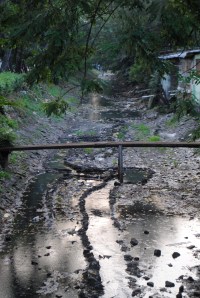
Jakarta Globe, September 8, 2011
When a choked stream of muddy water spluttered into my kitchen sink on Monday evening, I caught myself whooping with joy.
My home in Central Jakarta was one of the estimated 250,000 to suffer through the citywide water crisis caused by a burst dike in the Kalimalang River last week. Our water supply was cut off for nearly six full days.
Having grown up in the midst of an extended drought in Australia, I’m no stranger to the idea of reduced water usage. But last week’s crisis took things to a whole new level. Our water supply was reduced to a dribble last Wednesday morning. One of my housemates had the foresight to fill up the mandi tub while the water lasted, a process that took almost two hours.
For the first couple of days, there was enough water between us to take a quick splash, soak the dishes and flush the toilet. But as the water level dropped and its promised return was continually postponed, things started to look dire. What was left in the mandi was swarming with mosquito larvae and had to be emptied.
My housemates and I took to showering at the gym and begging showers from friends. The dishes no longer fit in the tub in the kitchen and were crawling with ants. The overflowing laundry basket began to resemble a fourth housemate, swelling to the size of a small child. Eventually, our drinking water ran out and we discovered our neighborhood suppliers had also run dry. When the toilet stopped flushing, we decided it was time to evacuate.
Faced with the desperation of trying to perform daily tasks without a drop of water, a blindingly obvious realization occurred to me: Water, it seems, is essential for life.
It’s something you hear all the time from environmentalists and NGO types, but until last week’s crisis, I’d never realized just how important a water supply is to maintaining even a basic level of sanitation.
In July this year, the United Nations passed a resolution declaring access to “safe and clean drinking water and sanitation” a human right. A quick look at the state of things here in Jakarta shows that fulfilling that right will be a huge challenge.
Even when the taps are flowing, the city’s supply is still in a state of crisis. It is highly polluted, erratically delivered and, for a large number of households, prohibitively expensive. The majority of Jakartans receive their water through the city’s piped supply, while a significant remainder gets it from private vendors, household wells or public waterways.
Two major foreign companies control the city’s piped water systems: Britain’s Thames Water Overseas and France’s Suez Lyonnaise des Eaux. These two firms took control of the city’s water in the final months of the late President Suharto’s rule.
Privatizing the city’s water supply was a controversial decision at the time, made without public consultation or bidding and pushed by figures close to the former president. After Suharto’s fall, the Jakarta Water Supply Regulatory Body was formed to monitor the two companies. But even under scrutiny, the companies have not succeeded in significantly increasing access to water for sanitation in the city, let alone for drinking.
Asian Development Bank statistics show that nationwide, there are more than 100 million people without access to safe drinking water. The effects of this everyday crisis go way beyond ant-covered dishes or bulging laundry baskets. Unsafe drinking water helps spread diseases such as cholera, dysentery and typhoid. It is also a common cause of diarrhea, a leading killer of children under the age of 5 in Indonesia.
Most people in Jakarta purchase treated water for drinking, or boil it from the tap, an expensive option for low-income people because of the fuel required for boiling. And even after it’s boiled, tap water may still not be safe for drinking because of pollution in the city’s waterways.
The temporary crisis that caused only discomfort and inconvenience in my household is symptomatic of a much larger one that affects many Jakartans every day.
That the Kalimalang dike managed to burst in the middle of the dry season, when water flows are at a minimum, suggests something is amiss in the city’s maintenance of its waterways. With any luck, the fallout from last week’s crisis will prompt a closer look at improving the quality and access to one of life’s essentials for the people of Jakarta.
Catriona Richards is a copy editor at the Jakarta Globe.

 Catriona Richards
Leave a comment